

Sustainable Restaurant Design in 2026: A Complete Guide for US Operators
Sustainable Restaurant Design in 2026: A Complete Guide for US Operators
Sustainable restaurant design starts on the utility bill, not the mission statement. Restaurants use roughly five to seven times more energy per square foot than other commercial buildings such as offices or stores, and high-volume quick-service restaurants can reach ten times that figure. Guests track it too. In Toast’s 2025 blind survey, 73% of respondents said a restaurant’s approach to sustainability is an important factor in deciding where to eat.
How to make a restaurant more sustainable? Cut energy and water at the equipment level, measure food waste before you manage it, shorten your supply chain, and verify the result through third-party certification.
The Business Case for a Sustainable Restaurant
Restaurant net margins sit in single digits. That math works in your favor. At a 5% net margin, every dollar of avoided utility cost carries the same weight as $20 in incremental sales. An eco-friendly restaurant does not spend its way to virtue. It strips recurring cost from the P&L and keeps the savings compounding across the equipment lifecycle.
The pressure is sharper in the Caribbean. A 2022 World Bank study puts regional electricity around US$0.25 per kWh, more than double the US average, and above US$0.40 in some countries. A measure that pays back in five years in Ohio pays back in two in Nassau or George Town. Add guest preference and staff retention, and the case closes itself.
Energy-Efficient Kitchens
The hood is where kitchen efficiency starts. Ventilation is the single largest energy user in most commercial kitchens, and standard systems run exhaust fans at full speed regardless of what is on the line. Demand control kitchen ventilation modulates fan speed against actual cooking activity. EPA field studies behind the ENERGY STAR Emerging Technology Award suggest savings of 60% or more in ventilation energy.
Equipment decisions follow the same logic. ENERGY STAR certified models offer energy savings of 10 to 70 percent over standard units, depending on the product category. Prioritize ventilation and refrigeration, since it runs 24 hours a day. Then move to certified dishwashers, ice machines and steam cookers, which also save water and lower your water and sewer bills.
Induction changes the BOH thermal profile. According to Frontier Energy, which operates the Food Service Technology Center, gas cooktops run in the 30% to 40% efficiency range, electric resistance sits around 60% to 70%, and induction reaches roughly 80% to 90%. Less waste heat means a smaller HVAC load and a cooler line for your cooks.
The equipment list is the easy part. Sizing the hood against your actual cookline, and sequencing the retrofit so you capture utility rebates before you buy, is where most operators lose the payback they were counting on.
Water Efficiency in Foodservice
Pre-rinse spray valves account for nearly one-third of the water used in the typical commercial kitchen. Since 2019, the federal standard adopted the old WaterSense threshold, capping new units between 1.00 and 1.28 gallons per minute depending on spray force class, with lifecycle testing behind it. If your valve predates that rule and runs at 1.6 gpm or higher, you are paying for water the standard no longer allows.
The payback is immediate. EPA estimates that replacing one obsolete valve with a DOE-compliant model saves a commercial kitchen more than 7,000 gallons per year and between $110 and $200 in combined water and energy costs, because most of that water is heated.
Local and Sustainable Sourcing
Local sourcing fails when operators treat it as a purchasing swap instead of a relationship. Give growers forward commitments for the season, agree on split cases, and build menu windows around what the region actually produces. Traceability documentation matters as much as the produce, because it becomes the evidence behind every claim you print.
The cost myth deserves a direct answer. Shorter menus, cross-utilization and whole-crop purchasing offset the premium on individual line items, and GP% often improves once waste drops. Name your farms on the menu. Toast found that 44% of respondents are most encouraged to visit a restaurant that uses locally sourced ingredients.
Waste Management Beyond Recycling
Measurement comes before any bin. A 2019 review by Champions 12.3 reviewed 114 restaurants across 12 countries and found the average site saved $7 for every $1 invested in reducing kitchen food waste. Within one year, food waste dropped 26 percent on average and over 75 percent of sites had recouped their investment. Every site kept total investment below $20,000.
Tracking platforms such as Leanpath and Winnow turn that into daily practice by weighing and categorizing what leaves the kitchen. Layer on back-of-house composting,a fats, oils and grease (FOG) program with a documented grease trap maintenance schedule, and a donation program. The Bill Emerson Good Samaritan Food Donation Act, passed in 1996 and amended by the Food Donation Improvement Act, gives US restaurants federal civil and criminal liability protection when donating food, provided certain requirements are met.
Platforms measure. They do not tell you which line item to attack first, or how to hold the reduction once the novelty wears off. The 26% figure belongs to sites that had someone owning the program.
About the Materials and Interior Design
Finishes decide your restaurant carbon footprint at construction and your air quality afterward. Specify low-VOC paints, adhesives and sealants, FSC certified or reclaimed wood, and recycled-content tile. Reclaimed material also solves a design problem, since the wear a salvaged bar top carries cannot be ordered from a supplier catalog.
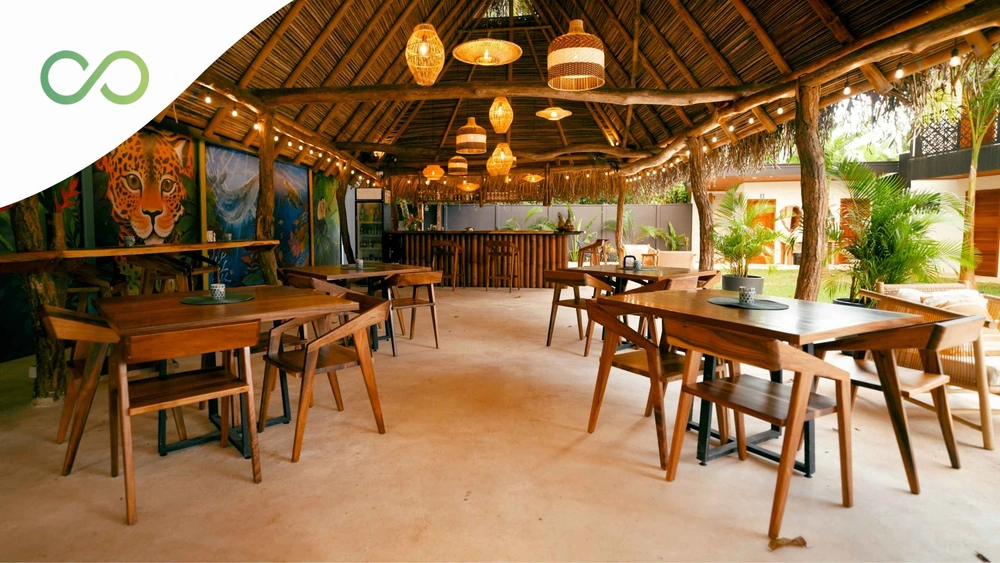
Indoor air quality belongs in the same conversation. Balanced makeup air keeps smoke and heat inside the hood instead of the dining room. Biophilic elements read as authentic when they connect to the sourcing story rather than decorate around it.
Green Certifications for Restaurants
Green restaurant certification turns claims into audited facts. The Green Restaurant Association, founded in 1990, awards GreenPoints across eight categories: Energy, Water, Waste, Reusables & Disposables, Chemicals & Pollution, Food, Building & Furnishing, Education & Transparency. Certification is granted at four ascending levels, and every Certified Green Restaurant must run full-scale recycling and composting programs, be free of polystyrene packaging, and fulfill annual education requirements.
GRA fits single sites and small groups because it measures operations, not just the building. LEED addresses new construction and major renovation and requires a design-phase commitment. ENERGY STAR benchmarks whole-building performance. The 2026 Greenest Restaurant Award went to Carvers’ Cafe at Mt. Rushmore, operated by Xanterra, with 477.65 GreenPoints and on-site solar generating over 57 percent of its energy use.
Choosing between them is a strategy decision, not a paperwork decision. The wrong certification path costs a year and a design cycle. Greenloop maps operators to the standard their building, their market and their timeline can actually support.
Case Examples of Sustainable Design
Chipotle runs the most visible experiment. Its responsible restaurant design, piloted in 2023, is all electric and powers those specific locations with 100% renewable energy through certified renewable energy credits. Company-wide the picture is a work in progress, which is the honest part: the 2024 report logged a 15% cut in Scope 1 and 2 emissions against a 2019 baseline, 61% of electricity purchased from renewable sources, and 47 million pounds of local produce. The 2030 science-based target covers Scope 1, 2 and 3 at 50%.
Scale is not the prerequisite. Carvers’ Cafe is a single concession operation inside a national memorial, and it holds the highest GreenPoints total of any Certified Green Restaurant. The differentiator was sequence, with solar and BOH composting layered onto an operation that had already fixed its energy, water and waste basics.
Scope 1 and 2 you can assemble from utility bills. Scope 3 requires supplier engagement, and that is where most restaurant footprints stall.
Time to Solve some Common Doubts
GRA quotes by concept size, revenue and service model. Budget for the operational changes themselves, which usually exceed the certification fee.
Does sustainable kitchen design raise build cost?
Certified equipment carries a purchase premium. Utility rebates and total cost of ownership across a 10 to 15 year lifecycle usually close that gap.
Pre-rinse spray valves and LED retrofits. Low cost, one-day install, and both cut energy and water at once.
Start with Scope 1 and 2, meaning on-site fuel and purchased electricity. Utility data covers most of it. Scope 3, mainly food purchasing, needs supplier data.
No. Transport is a small share of most food emissions. Production method matters more, so a local hothouse tomato can exceed a field-grown import.
Start With the Baseline, Not the Certificate
Sustainable restaurant design rewards sequence over ambition. Measure your energy, water and waste baseline. Fix the ventilation and refrigeration loads that dominate the bill. Pursue certification once the operation already earns it.
Certification confirms performance. It does not create it.
Greenloop’s sustainability audit for foodservice gives you that baseline in writing: a metered read on your energy, water and waste loads, the three retrofits ranked by payback in your utility market, the rebates you qualify for before you buy, and a realistic certification path if you want one.
Not ready for a full audit? Tell us your square footage and last twelve months of utility spend, and we will tell you whether the numbers justify one.
Explore more Insights




Want to stay updated?
If you enjoyed this content and want to stay updated on ideas, projects, events, and insights shaping the future of high-performing buildings, subscribe to our Insights Blog