

How Hotels Reach Net Zero: A 7-Step Roadmap for US and Caribbean Operators
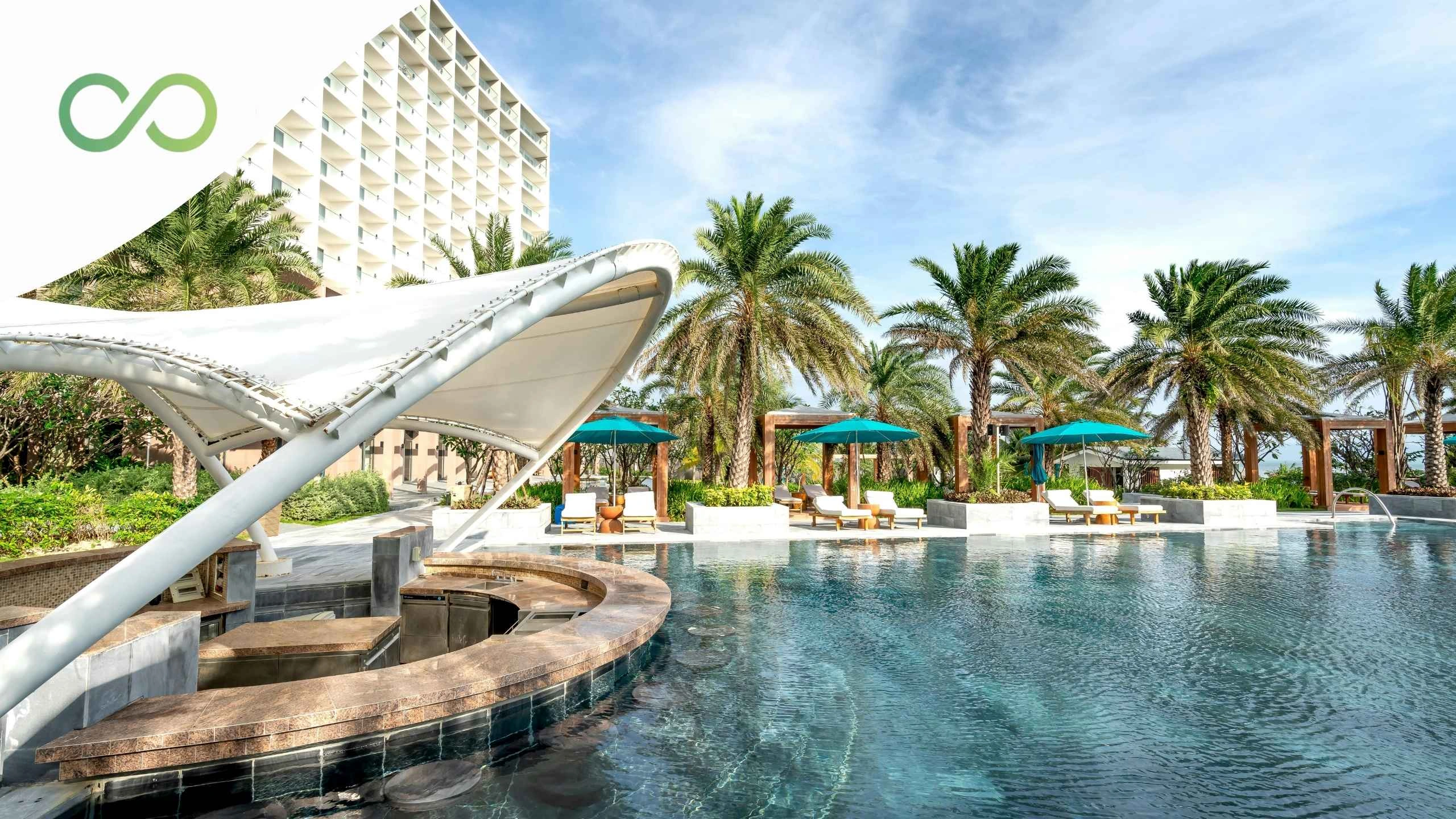
Learn how a net zero hotel is actually built: measure your baseline, cut energy demand, electrify, add renewables, attack Scope 3, then neutralize only the residue. Understand real timelines, costs, and what SBTi requires.
Marriott holds SBTi-validated near-term and long-term targets, committing the company to net zero across its value chain by 2050 and to a 46.2% cut in absolute Scope 1 and 2 emissions by 2030 from a 2019 base year. Hilton, Hyatt, IHG and Accor carry SBTi-validated targets too.
A net zero hotel is not a property that buys credits to cancel its footprint. It cuts roughly 90% of emissions across all three scopes, then neutralizes the small residue with permanent carbon removal. Sequence matters more than ambition.
What does net zero mean for a hotel?
Net zero rests on the GHG Protocol’s three scopes. Scope 1 includes emissions from sources you control on site, such as gas boilers, kitchen ranges, backup generators, shuttle vans, and refrigerant leaks. Purchased electricity used for HVAC, elevators, lighting, and laundry falls under Scope 2. Meanwhile, Scope 3 includes emissions generated across the rest of your value chain.
Food and beverage procurement, outsourced laundry, guest travel, furniture and equipment, construction materials, franchisee operations. Most carbon neutral hotel claims stop at Scopes 1 and 2 and pay for the rest. That is compensation, not decarbonization.
Step 1: Measure your baseline
You cannot decarbonize what you have not measured, and hotel operations generate more measurable data than most owners realize. Start with 12 months of utility bills, fuel deliveries, refrigerant logs and outsourced laundry volumes. That covers Scopes 1 and 2 using data you already hold.
For context, use the Cornell Hotel Sustainability Benchmarking Index, run by Cornell’s Center for Hospitality Research with Greenview since 2013 and drawing on more than 31,500 hotels. It applies the HCMI methodology and lets you compare carbon, energy and water against peers in your climate zone and asset class. [Enlace interno: Huella de Carbono Hoteles ESP]
Step 2: Cut energy demand first
Every kilowatt-hour you avoid is one you never have to generate, buy or offset. Retro-commissioning, LED retrofits, guestroom occupancy controls, laundry heat recovery and envelope sealing pay back fast and shrink the solar array you will need later.
Deeper work follows: chiller replacement, variable-speed pumps, window upgrades. Efficiency packages financed through C-PACE typically deliver 15% to 40% energy reductions depending on the building’s starting condition. Model the measures before you buy them.
Most owners discover their biggest savings are not where they assumed. Green Loop’s energy audits map consumption by system before a single piece of equipment gets specified.
Step 3: Electrify what burns fuel
Scope 1 disappears only when combustion does. Heat pump water heating handles the largest single fuel load in most full-service properties. Induction replaces gas in kitchens. Electric laundry and EV charging complete the shift.
Hotel Marcel in New Haven proves the model works at scale. The 165-room Tapestry Collection property has no gas hookup, runs on electricity, and holds both Passive House and LEED Platinum certification.
Step 4: Add renewable supply
Once demand is low and loads are electric, renewables cost less because the system you need is smaller. Rooftop and carport solar is the US default, backed by power purchase agreements where roof area falls short.
Caribbean arithmetic is sharper. Commercial electricity in Jamaica ran near USD 0.238 per kWh in September of 2025, so solar paired with storage displaces expensive imported fuel and keeps the property running through outages.
Step 5: Attack Scope 3, the hardest part
Scope 3 dominates the footprint, though the exact share varies more than most benchmarks admit. Sector estimates place it between 70% and 90% of a portfolio total, with food and beverage procurement as the single largest line item.
A 2026 life-cycle study of four full-service hotels found F&B alone at 40% to 58% of the annual footprint once procurement entered the boundary. Your own number will depend on your F&B mix and whether guest travel sits inside your boundary. That is exactly why the baseline comes before the target.
Step 6: Use removals only for the residue
Offsets belong to the last 5% to 10%, never to the strategy. The SBTi requires roughly 90% absolute reduction before any neutralization, and permanent removals rather than avoidance credits for what remains.
When you do buy, diligence the methodology, not the registry name. Look for the ICVCM Core Carbon Principles label, which sits on top of programs like Verra’s VCS and Gold Standard and tests additionality, permanence, quantification and double counting. Project-level ratings close the remaining gap.
Step 7: Verify and report
Self-declared Net-Zero hospitality claims carry legal and reputational exposure. SBTi validation is the recognized benchmark, and the Corporate Net-Zero Standard V2.0, published on 11 June 2026, tightens it with separate Scope 1 and Scope 2 targets, obligatory transition plans and 3rd parties assurance for larger companies.
V2.0 takes over target validation from 2027, with a transition window running into 2028. Pair it with GRI or CDP disclosure and property-level certification. [Enlace interno: Hotel Certifications]

Realistic timelines and cost
Five to fifteen years is the honest range, and your starting point decides where you land. A recent all-electric build in a decarbonizing grid gets there fast. A 1970s resort on a diesel-heavy island does not.
Financing changes the arithmetic. C-PACE covers up to 100% of eligible costs,repaid through a property tax assessment over 20 to 30 years. One Westchester hotel financed a $2.5 million retrofit, captured $300,000 in utility incentives and cut $263,000 a year, an 8.4-year payback. Enabling legislation is active in 40 states plus D.C., and programs are operating in 36 states plus D.C.
Solving some common doubts
Measure a full Scope 1, 2 and 3 baseline, cut energy demand, electrify combustion, add renewables, reduce procurement emissions, then neutralize the residual 5% to 10% with permanent removal and verify the pathway.
No. Carbon neutral usually means offsetting current emissions. Net zero requires cutting them by roughly 90% first.
Scope 3, at roughly 70% to 90% of a full footprint, driven mostly by food and beverage procurement.
No. Carbon credits cannot be counted toward reduction targets. They apply only to residual emissions at the net zero year.
Scopes 1 and 2 use data you already hold. Scope 3 requires supplier engagement and estimation, which absorbs most of the effort.
Start with the baseline, not the pledge
The gap between groups that hit their 2030 interim targets and those that miss will come down to sequencing. Operators who measured first, cut demand, then electrified are running ahead of schedule. Operators who announced first are now buying credits to cover a number they never audited.
The clock is also structural. From 1 February 2028, every new target submission must meet SBTi V2.0, which means a verified inventory, a published transition plan and third-party assurance. Baselines built next year will validate. Baselines built in 2028 will be rushed.
Green Loop builds the baseline first. We measure your full Scope 1, 2 and 3 footprint, audit your building systems, and hand you a cost sequence of measures with modeled savings, not a pledge.
Book a free one-hour Net Zero Pathway call. You leave with your three highest-return measures and a realistic timeline for your property, whether or not you work with us.
Explore more Insights

Want to stay updated?
If you enjoyed this content and want to stay updated on ideas, projects, events, and insights shaping the future of high-performing buildings, subscribe to our Insights Blog